


Find N Seek: Spy Hidden Object
4.95.08K Reviews
App Specs
- Version
- 1.4.4
- Updated On
- License
- Free
- Downloads
- 10,000,000+
- Developer
- Joymaster Puzzle Game Studio
- Categories
- Puzzle
- Platform
- Android
Screenshots


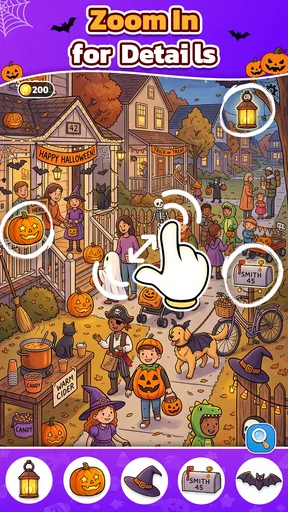
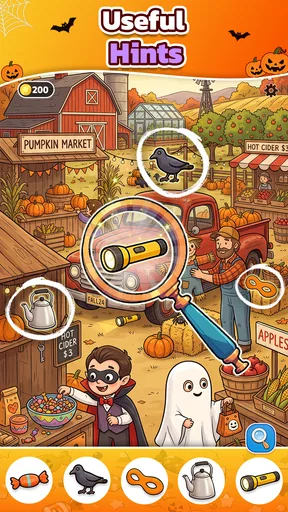




 Analysis by AppCompare
I started Find N Seek expecting a simple hidden-object distraction, but its appeal became clearer after several short sessions. The game places me in puzzle scenes where I search for concealed items, tap what I recognize, and keep scanning when the picture refuses to give up its secrets. That basic action is easy to understand, yet the changing density of each scene gives it enough tension to keep me looking.
It is a free puzzle game from Joymaster Puzzle Game Studio, suitable for Everyone and available on devices running Android 6.0 or later. The current version is 1.4.4. Its store summary describes a relaxing mystery scavenger hunt, and that is a fair description of the mood: this is more about observation and patience than speed, reflexes, or complicated rules.
How the hidden-object loop feels in practice
I find the hidden-object loop works best when I treat each scene as a small search problem rather than a test of speed: a deliberate scan makes the discoveries feel earned and helps prevent aimless tapping. The useful question is how that simple rhythm holds up across a real break, especially when attention is limited.
The first action is deliberately simple
Every round begins with the same useful question: where should I look first? I scan the whole scene, pick out anything that resembles a target, and tap it. The controls do not get in the way, so the challenge comes from visual attention rather than learning a control scheme. That makes it comfortable for a quick break, especially when I want a game that starts immediately.
The best way to approach a scene is not to sweep randomly across it. I get better results by dividing the image into zones, such as the upper corners, the center, the foreground, and the edges. This prevents me from repeatedly checking the same obvious area while overlooking a small object near a busy background. It also gives the search a steady rhythm instead of turning it into frantic tapping.
Some objects stand out quickly, while others blend into the surrounding shapes or colors. The contrast between those two types of finds is what gives the game its mild mystery. A round can feel nearly solved, then one remaining item forces me to slow down and inspect the image again. I enjoy that final stretch more than the opening scan because it rewards careful comparison rather than first impressions.
That said, this is not a puzzle for players who need elaborate logic, story decisions, or changing controls. The central task remains visual searching. If you prefer word puzzles, number puzzles, or action games with constant new mechanics, the simplicity may feel limited. I see that as an important boundary: the game is strongest when I want focused observation, not when I want a broad adventure.
Worth Reading Before You Choose

EA SPORTS FC Mobile 26 Is a Bigger Football Game, but It Takes Time

Flipboard Shows What News Apps Must Do Beyond the Feed

Switching to Android Auto Means Rethinking Your Driving Routine

Google Calendar Makes a Crowded Week Easier to Manage

Ludo King Makes the Most of the Minutes Between Plans

Baby Panda World Brings Quick Play to Modern Phones, but Its Game Library Feels Busy
The feedback rhythm keeps the search moving
Each correct discovery gives the search a small sense of progress. I tap an item, see that the choice was accepted, and immediately return to the image with fewer possibilities left to consider. That feedback matters because hidden-object games can otherwise feel like staring at a static picture. Here, every successful tap confirms that my attention is working and encourages another pass through the scene.
The rhythm is easy to describe: scan, identify, tap, confirm, and scan again. When I find several objects close together, the round feels almost effortless. When the remaining items are harder to spot, the same loop becomes more deliberate. The game does not need a complicated reward animation to make that progression understandable; the shrinking list of things to find is already a clear signal.
I also found that the feedback changes how I use my eyes. Instead of asking whether an area looks interesting, I ask whether it contains a shape that does not quite belong. A slight color difference, an unusual outline, or an object placed where I would not expect it can become the clue. This makes the game useful as a short concentration exercise, although I would not mistake it for a formal training tool.
One practical tip is to pause after a wrong assumption rather than tapping repeatedly around the same spot. If an item seems partly hidden, I look for its complete outline and compare it with the target image or wording. Random tapping wastes attention and can make a scene feel harder than it is. A systematic sweep is slower for a few seconds but usually more reliable.
The feedback loop also explains why the game works well without demanding long attention spans. I can make meaningful progress after finding only one object, then decide whether to continue. A player who enjoys visible, incremental progress will probably appreciate this more than someone who wants a single dramatic solution at the end of a level.
What counts as a reward here
The main reward is the feeling of clearing visual clutter. Each discovery removes one uncertainty, and finishing a scene provides a neat sense of completion. I like that the reward is connected directly to the skill being tested: noticing details. It does not feel as though I am merely waiting for a timer or collecting points unrelated to the search itself.
The relaxing side of the game comes from that direct connection. I can play while taking a short break, after finishing a routine task, or when I want something quieter than a competitive game. A realistic use case is a few minutes on public transport: I can open a scene, search at my own pace, and stop once my attention starts to wander. The game fits that situation better than a title that requires a long uninterrupted match.
There is also a useful psychological reward in returning to a scene after getting stuck. Once I stop staring at it continuously, my eyes often notice a detail more quickly on the next attempt. I recommend treating a difficult search as a visual reset rather than a personal failure. Looking away briefly, changing the order of the scan, and coming back with a fresh starting point can be more effective than increasing tapping speed.
Still, the reward has a ceiling. Finding hidden objects is satisfying, but it does not provide the same variety as a puzzle game that alternates between spatial reasoning, deduction, and pattern matching. If I play for too long in one sitting, the basic loop can begin to feel repetitive. The free entry point makes it easy to try, but players should choose it for calm observation rather than deep mechanical variety.
The game has attracted a strong audience, with an average rating of 4.9 from around 243 thousand ratings and more than 10 million installs. Those figures suggest that the straightforward design connects with many players, but they do not change my own conclusion: its value depends on whether you genuinely enjoy searching pictures for small details.
Why another session begins
After completing a scene, the reason to start again is simple: the next search offers another chance to repeat the same satisfying process with a different visual problem. I do not need to relearn the controls, so the barrier between one round and the next is low. That makes the game easy to revisit during scattered moments rather than something I need to schedule as a serious gaming session.
The reset is especially effective when I stop before I become tired. I prefer ending after a completed search or a useful breakthrough, because that leaves the game associated with a small success. If I continue while my attention is fading, every object begins to look equally plausible and the relaxing quality disappears. In that sense, the best session length is determined by my concentration, not by a need to reach a particular milestone.
Another reason to return is the chance to improve my method. The first attempt at this type of game often involves broad scanning and impulsive taps. Later, I naturally become more disciplined: I check borders, inspect crowded areas, and reserve the most visually confusing section for a final focused pass. That personal improvement gives repeated sessions a little more purpose than simply starting over.
However, the reset will not satisfy everyone. Players who expect a persistent narrative, character development, or a large strategic system may wonder what they are working toward beyond the next completed search. This is a deliberately narrow experience. It resets because the pleasure is in solving another visual scene, not in building a long-term fictional world.
Using the game without making it harder than necessary
I recommend playing with the device held steadily and with enough screen space to inspect the image comfortably. Small details are easier to judge when I am not rushing, and a stable grip reduces accidental taps. I also avoid searching with a constantly moving finger over the scene; that makes it harder to remember which areas I have already checked.
A helpful routine is to begin with the least crowded areas, then move toward the busiest section. This gives me early confirmations and establishes the visual style of the scene before I tackle the difficult cluster. When only a few targets remain, I mentally divide the screen into a grid and inspect each cell once. That approach is more dependable than zooming mentally into one suspicious object and ignoring everything around it.
Another non-obvious trade-off is that the game rewards patience more than raw visual speed. A fast player may identify obvious objects quickly but still lose time on the final hidden item by assuming it must be in an expected location. A slower player who notices unusual placement can finish more consistently. I found that deliberately changing my search order between sessions keeps the loop from becoming automatic.
For younger players, the Everyone rating makes the game approachable, and the rules are simple enough to understand without a long explanation. I would still encourage an adult to decide whether the child is comfortable with the visual challenge and any purchase prompts that may appear in a free game. For adults, it works well as a low-pressure attention break, provided they are happy with the narrow focus.
Free access and the practical trade-off
The game is free to download and play, with in-app purchases ranging from $1.99 to $45.99 per item. That makes trying it straightforward, but the wide purchase range is worth keeping in mind before handing the device to a child or treating the game as completely cost-free. I would approach the optional spending carefully and decide in advance whether I want to make any purchases at all.
For me, the free starting point is enough to judge the core loop: can I enjoy searching, and do the scenes hold my attention? I would not install it expecting a premium, one-time purchase experience with every part of the game presented in the same way. Players who dislike in-app purchase structures should be cautious, while those who are comfortable with free puzzle games can sample it without an upfront price.
The current version, 1.4.4, is a practical detail for anyone checking compatibility or deciding whether an older device can run it. Support for Android 6.0 or later covers a broad range of phones and tablets, although the comfort of searching still depends on screen size and display clarity. A larger tablet can make tiny objects easier to inspect, while a compact phone is more convenient for short sessions on the move.
Where it stands beside other puzzle choices
Compared with match-three games, this title asks for observation instead of pattern construction. There is no need to plan chains or manage a board after every move. Compared with crossword or word-search games, it relies on visual recognition rather than vocabulary. And compared with logic puzzles, it usually offers a gentler mental demand: the answer is somewhere in front of me, but I must notice it.
That difference makes it a good alternative when I want to rest my mind without switching it off completely. It is less suitable when I want a measurable strategic challenge or a puzzle with several possible solution paths. A traditional logic game is the better choice for someone who enjoys deduction; a competitive puzzle game is better for someone who needs pressure and a clear performance target.
Its strongest comparison point is accessibility. I can understand the objective almost immediately, and the search loop does not require a tutorial-heavy introduction. The weakness is the same feature viewed from another angle: because the objective is so clear and stable, the experience may not surprise experienced hidden-object players for very long. Newcomers are likely to get more from it than players already looking for complex genre innovation.
My verdict on the full loop
Find N Seek succeeds because its loop is clean: I inspect a scene, tap a suspected object, receive immediate confirmation, enjoy the satisfaction of reducing the search, and begin again when I want another small challenge. The action is understandable, the feedback is useful, the reward matches the task, and the reset does not feel like a punishment. That is a solid foundation for a relaxing puzzle game.
I would recommend it to someone who likes hidden-object searches, wants a casual game for short breaks, or prefers concentration without timers and complicated controls. It is also a reasonable choice for families looking for an approachable visual puzzle, with the usual care around optional purchases. The game is at its best when played in focused bursts, using a deliberate scan instead of frantic tapping.
I would skip it if I need a rich story, deep strategy, competitive rankings, or constantly changing mechanics. The repeated search structure is the whole point, and anyone who finds that activity repetitive will reach the limit quickly. For everyone else, the combination of free access, a calm pace, and clear visual progress makes it an easy game to keep available for those moments when I want to unwind but still do something.
My final recommendation is measured but positive: try it when you want a quiet scavenger hunt rather than a demanding puzzle marathon. Give the first scenes enough patience to learn how the objects are disguised, use a zone-by-zone search, and stop when the screen stops feeling relaxing. If that rhythm suits you, Joymaster Puzzle Game Studio has built a pleasantly focused way to turn a few spare minutes into a small, satisfying investigation.
Pros
- Clever hiding spots make each level feel rewarding to explore.
- Short rounds fit well into quick gaming sessions.
- Bright visuals make hidden objects easy to distinguish.
- Simple controls are suitable for players of most ages.
- New scenes provide enough variety to keep searches interesting.
Cons
- Some objects blend into the scenery too closely.
- Later stages can feel repetitive after extended play.
- Hints may be limited or require watching an advertisement.
- The game can become difficult without careful screen scanning.
- Frequent ads may interrupt the flow between levels.
FAQs for Find N Seek: Spy Hidden Object
What is Find N Seek: Spy Hidden Object?
Find N Seek: Spy Hidden Object is a casual puzzle game built around searching detailed scenes for hidden characters, objects, and clues. You play as a spy-style investigator, examining busy illustrations and completing objectives by tapping the correct items. The game is designed for short sessions, but increasingly crowded scenes and time-based challenges can make later levels more demanding.
How do you play Find N Seek: Spy Hidden Object?
Each level presents a visual scene containing many small details and asks you to locate specific targets. You can scan the image, zoom in when available, and tap objects as you find them. Correct discoveries advance the investigation, while missed taps or limited time may affect your progress. Careful observation is usually more useful than tapping randomly.
Is Find N Seek: Spy Hidden Object free to download and play?
The game can generally be downloaded without an upfront purchase, allowing players to try its hidden-object levels before spending money. However, free gameplay may include advertisements, optional purchases, or other limitations depending on the version and platform. Before downloading, check the current Google Play or App Store listing for pricing, ads, in-app purchases, and regional availability.
Does Find N Seek: Spy Hidden Object require an internet connection?
Some parts of Find N Seek: Spy Hidden Object may work without a constant connection, particularly previously loaded puzzle levels. Nevertheless, internet access can be required for advertisements, optional rewards, purchases, updates, analytics, or newly downloaded content. If you plan to play while traveling or offline, test the game first and avoid assuming every feature will remain available without connectivity.
Is Find N Seek: Spy Hidden Object suitable for children?
The game is generally approachable for players who enjoy visual puzzles, observation challenges, and simple tap-based controls. Its spy and investigation theme is presented in a light, cartoon-like format rather than as a realistic action game. Parents should still review the store age rating, advertising, in-app purchase settings, and privacy information, especially when the app is installed on a child’s device.


